
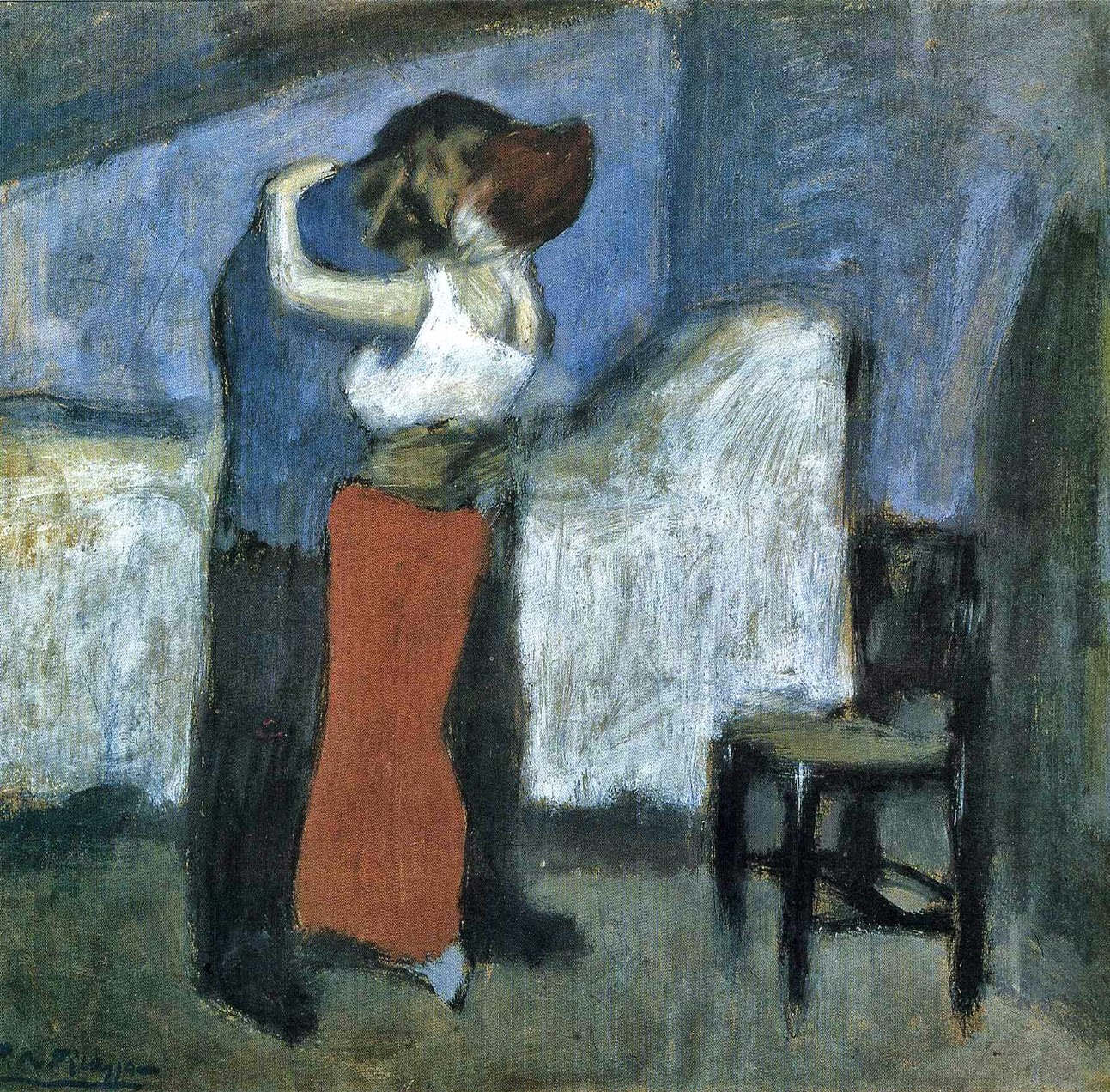
Spanish art has been an important contributor to Western art and Spain has produced many famous and influential artists including Velázquez, Goya and Picasso.
Spanish art was particularly influenced by Italy and France during the Baroque and Neoclassical periods, but Spanish art has often had very distinctive characteristics, partly explained by the Moorish heritage in Spain (especially in Andalusia), and through the political and cultural climate in Spain during the Counter-Reformation and the subsequent eclipse of Spanish power under the Bourbon dynasty.
.jpg)
The prehistoric art of Spain had many important periods-it was one of the main centres of European Upper Paleolithic art and the rock art of the Spanish Levant in the subsequent periods.
In the Iron Age north-western Spain was a centre for Celtic art, and Iberian sculpture has a distinct style, partly influenced by coastal Greek settlements.
Spain was conquered by the Romans by 200 BC and Rome was rather smoothly replaced by the Germanic Visigoths in the 5th century AD, who represented only a small ruling class, who soon Christianized.
.jpg)
Francisco Ribera Gomez (1907-1990)
The relatively few remains of Visigothic art and architecture show an attractive and distinct version of wider European trends, but the Muslim conquest of most of Spain in the 8th century was a massive disruption and transformation.
Over the following centuries the wealthy courts of Al-Andaluz produced many works of exceptional quality, culminating in the Alhambra in Granada, right at the end of Muslim Spain.
Meanwhile, the parts of Spain remaining Christian, or that were re-conquered, were prominent in Pre-Romanesque and Romanesque art, especially in Catalonia.
.jpg "Francisco Ribera Gomez (1907-1990)")
Francisco Ribera Gomez (1907-1990)
Late Gothic Spanish art flourished under the unified monarchy in the Isabelline Gothic and Plateresque styles, and the already strong traditions in painting and sculpture began to benefit from the influence of imported Italian artists.
.jpg "Francisco Ribera Gomez (1907-1990)")
Francisco Ribera Gomez (1907-1990)
The enormous wealth that followed the flood of American gold saw lavish spending on the arts in Spain, much of it directed at religious art in the Counter-Reformation.
Spanish control of the leading centre of North European art, Flanders, from 1483 and also of the Kingdom of Naples from 1548, both ending in 1714, had a great influence on Spanish art, and the level of spending attracted artists from other areas, such as El Greco, Rubens and (from a safe distance) Titian in the Spanish Golden Age, as well as great native painters such as Diego Velázquez, José de Ribera, Francisco Zurbarán and Bartolomé Esteban Murillo.
Spanish Baroque architecture has survived in large quantity, and has both strains marked by exuberant extravagance, as in the Churrigueresque style, and a rather severe classicism, as in the work of Juan de Herrera.
.jpg "Jaume Plensa")
Jaume Plensa
It was generally the former which marked the emerging art and Spanish Colonial architecture of the Spanish Empire outside Europe, as in Latin America (New Spanish Baroque and Andean Baroque), while the Baroque Churches of the Philippines are simpler.
The decline of the Habsburg monarchy brought this period to an end, and Spanish art in the 18th and early-19th century was generally less exciting, with the huge exception of Francisco Goya.

Salvador Dali
The rest of 19th-century Spanish art followed European trends, generally at a conservative pace, until the Catalan movement of Modernisme, which initially was more a form of Art Nouveau. Picasso dominates Spanish Modernism in the usual English sense, but Juan Gris, Salvador Dalí and Joan Miró are other leading figures.
.jpg "Francisco Ribera Gomez (1907-1990)")
Francisco Ribera Gomez (1907-1990)
.jpg)
Francisco Ribera Gomez (1907-1990)
List of Spanish Artists: Painters, Sculptors, Photographers, Poets, Musicants, Writers and the artistic movements definition
++(1).jpg)
Joaquin Sorolla (1863-1923)

Salvador Dali

Pablo Picasso
 Facebook
 X
X
 LinkedIn
 Telegram
 WhatsApp
 Iscriviti al canale