Visualizzazione post con etichetta Vincent van Gogh. Mostra tutti i post
Vincent van Gogh | Irises, 1889-1890

Vincent van Gogh | Irises, 1889-1890

Vincent van Gogh (1853-1890) returned to irises again and again in the final year of his life.
While staying at the psychiatric institution in Saint-Rémy (1889-1890), the garden became one of his main sources of inspiration.
He painted several studies of irises over the course of about a year.
Sometimes a single flower, sometimes overflowing bouquets.
He experimented with colour, rhythm and composition.
A small detail: the irises we see as blue today were originally painted a vibrant purple.
Over time, some of Van Gogh’s pigments faded, subtly changing the colours.

Vincent van Gogh | Irises, 1889 | Getty Museum


Read More

Vincent van Gogh | Irises, 1889-1890

Vincent van Gogh (1853-1890) returned to irises again and again in the final year of his life.
While staying at the psychiatric institution in Saint-Rémy (1889-1890), the garden became one of his main sources of inspiration.
He painted several studies of irises over the course of about a year.
Sometimes a single flower, sometimes overflowing bouquets.
He experimented with colour, rhythm and composition.
A small detail: the irises we see as blue today were originally painted a vibrant purple.
Over time, some of Van Gogh’s pigments faded, subtly changing the colours.

Vincent van Gogh | Irises, 1889 | Getty Museum


Vincent Van Gogh | Sunset at Montmajour, 1888

Vincent Van Gogh | Sunset at Montmajour, 1888

Sunset at Montmajour is a landscape in oils painted by the Dutch artist Vincent van Gogh on 4 July 1888.
It was painted while the artist was at Arles, France and depicts a landscape of garrigue with the ruins of Montmajour Abbey in the background.
The painting is 73.3 cm × 93.3 cm (28.9 in × 36.7 in).
For over 100 years, it was in a Norwegian industrialist's private collection and wrongly assumed to be fake, before being re-examined, authenticated and sold to its current private owner.
The painting was temporarily on display from 24 September 2013 until 12 January 2014 as part of an exhibition at the Van Gogh Museum in Amsterdam.


Read More

Vincent Van Gogh | Sunset at Montmajour, 1888

Sunset at Montmajour is a landscape in oils painted by the Dutch artist Vincent van Gogh on 4 July 1888.
It was painted while the artist was at Arles, France and depicts a landscape of garrigue with the ruins of Montmajour Abbey in the background.
The painting is 73.3 cm × 93.3 cm (28.9 in × 36.7 in).
For over 100 years, it was in a Norwegian industrialist's private collection and wrongly assumed to be fake, before being re-examined, authenticated and sold to its current private owner.
The painting was temporarily on display from 24 September 2013 until 12 January 2014 as part of an exhibition at the Van Gogh Museum in Amsterdam.


Vincent van Gogh | Still lifes of Shoes

Vincent van Gogh | Still lifes of Shoes

Vincent van Gogh painted several still lifes of shoes, primarily between 1886-1888.
He found beauty in worn-out, mud-covered boots, viewing them as symbols of the "scars of life" and the long journeys of the working class.
Step into Van Gogh’s world, one shoe at a time Shoes were an unusual subject in Van Gogh’s time.
Most artists painted elegant still lifes, often symbolizing wealth.


Read More

Vincent van Gogh | Still lifes of Shoes

Vincent van Gogh painted several still lifes of shoes, primarily between 1886-1888.
He found beauty in worn-out, mud-covered boots, viewing them as symbols of the "scars of life" and the long journeys of the working class.
Step into Van Gogh’s world, one shoe at a time Shoes were an unusual subject in Van Gogh’s time.
Most artists painted elegant still lifes, often symbolizing wealth.


Van Gogh | Saintes-Maries (series)

Van Gogh | Saintes-Maries (series)

Saintes-Maries is the subject of a series of paintings that Vincent van Gogh made in 1888.
When Van Gogh lived in Arles, he took a trip to Saintes-Maries-de-la-Mer on the Mediterranean sea, where he made several paintings of the seascape and town.
The work he produced in Saintes-Maries took on a more experimental and expressive style than his earlier work.
Over the course of his visit, Van Gogh made two paintings of the sea, one of the village, and nine drawings.


Read More

Van Gogh | Saintes-Maries (series)

Saintes-Maries is the subject of a series of paintings that Vincent van Gogh made in 1888.
When Van Gogh lived in Arles, he took a trip to Saintes-Maries-de-la-Mer on the Mediterranean sea, where he made several paintings of the seascape and town.
The work he produced in Saintes-Maries took on a more experimental and expressive style than his earlier work.
Over the course of his visit, Van Gogh made two paintings of the sea, one of the village, and nine drawings.


Vincent van Gogh | Small bottle with peonies and blue delphiniums, 1886

Vincent van Gogh | Small bottle with peonies and blue delphiniums, 1886

Vincent van Gogh began experimenting with color in his still life flower series.
By the summer of 1885, the artist created some 40 paintings with a traditional approach, meaning that the flowers were in a vase and placed in the center of the canvas.
His 1886 painting Small Bottle with Peonies and Blue Delphiniums, done with oil on painter's board -a cheaper material than canvas-, from the Gemeente Museum collection, is one of them.
Flowers became the subject of many of the artist's works during this period.
But after painting over 10 species in mid-September, he sought out other subjects including fruit, shoes, fish and budding flower bulbs.

Vincent van Gogh | Small bottle with peonies and blue delphiniums, 1886 | Van Gogh Museum, Amsterdam

Read More

Vincent van Gogh | Small bottle with peonies and blue delphiniums, 1886

Vincent van Gogh began experimenting with color in his still life flower series.
By the summer of 1885, the artist created some 40 paintings with a traditional approach, meaning that the flowers were in a vase and placed in the center of the canvas.
His 1886 painting Small Bottle with Peonies and Blue Delphiniums, done with oil on painter's board -a cheaper material than canvas-, from the Gemeente Museum collection, is one of them.
Flowers became the subject of many of the artist's works during this period.
But after painting over 10 species in mid-September, he sought out other subjects including fruit, shoes, fish and budding flower bulbs.

Vincent van Gogh | Small bottle with peonies and blue delphiniums, 1886 | Van Gogh Museum, Amsterdam

Vincent van Gogh | Sunflowers series

Vincent van Gogh | Sunflowers series

Sunflowers (original title, in French: Tournesols) are the subject of two series of still life paintings by the Dutch painter Vincent van Gogh.
The earlier series, executed in Paris in 1887, depicts the flowers lying on the ground, while the second set, executed a year later in Arles, shows bouquets of sunflowers in a vase.
In the artist's mind both sets were linked by the name of his friend Paul Gauguin, who acquired two of the Paris versions.

Vincent van Gogh | Sunflowers, 1887 | National Gallery, London

Read More

Vincent van Gogh | Sunflowers series

Sunflowers (original title, in French: Tournesols) are the subject of two series of still life paintings by the Dutch painter Vincent van Gogh.
The earlier series, executed in Paris in 1887, depicts the flowers lying on the ground, while the second set, executed a year later in Arles, shows bouquets of sunflowers in a vase.
In the artist's mind both sets were linked by the name of his friend Paul Gauguin, who acquired two of the Paris versions.

Vincent van Gogh | Sunflowers, 1887 | National Gallery, London

Van Gogh's starry skies

Van Gogh's starry skies

"At present I absolutely want to paint a starry sky.
It often seems to me that night is still more richly coloured than the day; having hues of the most intense violets, blues and greens.
If only you pay attention to it you will see that certain stars are lemon-yellow, others pink or a green, blue and forget-me-not brilliance.
And without my expatiating on this theme it is obvious that putting little white dots on the blue-black is not enough to paint a starry sky" - Vincent van Gogh, Letter to Wilhelmina van Gogh, the sister, written 9 and 16 September 1888 in Arles.

Vincent van Gogh | Starry Night Over the Rhône, 1888 | Musée d'Orsay, Paris

Read More

Van Gogh's starry skies

"At present I absolutely want to paint a starry sky.
It often seems to me that night is still more richly coloured than the day; having hues of the most intense violets, blues and greens.
If only you pay attention to it you will see that certain stars are lemon-yellow, others pink or a green, blue and forget-me-not brilliance.
And without my expatiating on this theme it is obvious that putting little white dots on the blue-black is not enough to paint a starry sky" - Vincent van Gogh, Letter to Wilhelmina van Gogh, the sister, written 9 and 16 September 1888 in Arles.

Vincent van Gogh | Starry Night Over the Rhône, 1888 | Musée d'Orsay, Paris

Van Gogh's flowers

Van Gogh's flowers

Vincent van Gogh was a flower fan!
It all began in Paris, where he lived for two years (1886-88).
During his time there, he noticed that flower still lifes sold well.
Some French artists even specialised in painting flower still lifes.
Van Gogh started painting flower still lifes in the hope they would sell well.

Vincent van Gogh | Bouquet of Flowers in a Vase, 1890 | Metropolitan Museum of Art

Read More

Van Gogh's flowers

Vincent van Gogh was a flower fan!
It all began in Paris, where he lived for two years (1886-88).
During his time there, he noticed that flower still lifes sold well.
Some French artists even specialised in painting flower still lifes.
Van Gogh started painting flower still lifes in the hope they would sell well.

Vincent van Gogh | Bouquet of Flowers in a Vase, 1890 | Metropolitan Museum of Art

Vincent Van Gogh | Butterflies series

Vincent Van Gogh | Butterflies series

Butterflies is a series paintings made by Vincent van Gogh in 1889 and 1890.
Van Gogh made at least four paintings of butterflies and one of a moth.
The metamorphosis of the caterpillar into a butterfly was symbolic to Van Gogh of men and women's capability for transformation.

Vincent van Gogh | Butterflies and Poppies | Van Gogh Museum

Read More

Vincent Van Gogh | Butterflies series

Butterflies is a series paintings made by Vincent van Gogh in 1889 and 1890.
Van Gogh made at least four paintings of butterflies and one of a moth.
The metamorphosis of the caterpillar into a butterfly was symbolic to Van Gogh of men and women's capability for transformation.

Vincent van Gogh | Butterflies and Poppies | Van Gogh Museum

Vincent Van Gogh | A Lane near Arles, 1888

Vincent Van Gogh | A Lane near Arles, 1888

A Lane Near Arles (Allee bei Arles) was painted by Vincent van Gogh in 1888, while he was living in Arles.
It depicts a lane surrounded by trees running between the fields outside Arles, France.
A Lane Near Arles is currently in the collection of the Pommersches Landesmuseum, Greifswald, in Germany.
Vincent van Gogh settled in Arles in 1888 because he wanted "a different light".

Vincent Van Gogh | A Lane Near Arles, 1888 | Pomeranian State Museum Greifswald, Germany

Read More

Vincent Van Gogh | A Lane near Arles, 1888

A Lane Near Arles (Allee bei Arles) was painted by Vincent van Gogh in 1888, while he was living in Arles.
It depicts a lane surrounded by trees running between the fields outside Arles, France.
A Lane Near Arles is currently in the collection of the Pommersches Landesmuseum, Greifswald, in Germany.
Vincent van Gogh settled in Arles in 1888 because he wanted "a different light".

Vincent Van Gogh | A Lane Near Arles, 1888 | Pomeranian State Museum Greifswald, Germany

Vincent van Gogh | The Laundry Boat on the Seine at Asnières, 1887

Vincent van Gogh | The Laundry Boat on the Seine at Asnières, 1887

The Laundry Boat on the Seine at Asnières exemplifies some of the radical directions emerging from the paintings Vincent van Gogh (1853-1890) completed in Paris.
In March 1886, Van Gogh left his native Netherlands to reunite with his brother, Theo, in the French capital.
Soon after, he began meeting with several leading avant-garde artists whose works embodied strong reactions against the Impressionist tendencies that dominated the Parisian art world.
In 1887, Van Gogh took up residence in Asnières, a northwestern suburb of Paris, and his encounters with Signac and Gauguin proved catalytic for the painter's developing practice.

Vincent van Gogh | The Laundry Boat on the Seine at Asnières, 1887 | Virginia Museum of Fine Arts

Gauguin shared Van Gogh's enthusiasm for 19th-century Japanese woodblock prints and emulated their large planes of color in his burgeoning Synthetism and Cloisonnism techniques.
The compositional diagonals and strong contours in this painting recall both the distinctive divisions of the picture plane in Japanese landscapes and Gauguin’s simplified adaptation of these features.

The scene's striking chromatic contrasts and thickly layered brushstrokes also point to Van Gogh's interest in the experiments with complementary colors Seurat and Signac were making in these years.
The restaurant and park scenes and the views of the Seine that Van Gogh completed while living in Asnières began to demonstrate the indelible influence of Synthetism, Divisionism, and Pointillism even as a unique Post-Impressionist style was emerging in his paintings. | Virginia Museum of Fine Arts

Vincent van Gogh | Self-portrait as a painter, 1887-88

The Laundry Boat on the Seine at Asnières esemplifica alcune delle direzioni radicali emerse dai dipinti completati da Vincent van Gogh (1853-1890) a Parigi.
Nel marzo 1886, Van Gogh lasciò la natia Olanda per riunirsi al fratello Theo nella capitale francese.
Poco dopo, iniziò a incontrare diversi importanti artisti d'avanguardia le cui opere incarnavano forti reazioni contro le tendenze impressioniste che dominavano il mondo dell'arte parigino.

Nel 1887, Van Gogh si stabilì ad Asnières, un sobborgo nord-occidentale di Parigi, ed i suoi incontri con Signac e Gauguin si rivelarono catalizzatori per la pratica in via di sviluppo del pittore.
Gauguin condivideva l'entusiasmo di Van Gogh per le stampe xilografiche giapponesi del XIX secolo e ne emulò i grandi piani di colore nelle sue fiorenti tecniche di Sintetismo e Cloisonnisme.

Le diagonali compositive e i forti contorni in questo dipinto richiamano sia le divisioni distintive del piano pittorico nei paesaggi giapponesi sia l'adattamento semplificato di queste caratteristiche da parte di Gauguin.
I contrasti cromatici sorprendenti della scena e le pennellate spesse e stratificate indicano anche l'interesse di Van Gogh per gli esperimenti con colori complementari che Seurat e Signac stavano facendo in quegli anni.

Le scene del ristorante e del parco e le vedute della Senna che Van Gogh completò mentre viveva ad Asnières iniziarono a dimostrare l'influenza indelebile del sintetismo, del divisionismo e del puntinismo, anche se uno stile Post-impressionista unico stava emergendo nei suoi dipinti. | Virginia Museum of Fine Arts

More Asnières paintings by Vincent van Gogh

Vincent van Gogh | The restaurant Rispal in Asnières, 1887 | Museo Nelson-Atkins

Vincent van Gogh | Bridges across the Seine at Asnieres, 1887 | Collezione Bührle

Vincent van Gogh | Fishing in spring the Pont de Clichy (Asnieres), 1887 | Art Institute of Chicago

Vincent van Gogh | River Bank in Springtime, 1887 | Dallas Museum of Art

Vincent van Gogh | Restaurant de la Sirène at Asnières, 1887 | Musée d'Orsay

Vincent van Gogh | Fishing in Spring, the Pont de Clichy (Asnières), 1887 | Art Institute of Chicago

Read More

Vincent van Gogh | The Laundry Boat on the Seine at Asnières, 1887

The Laundry Boat on the Seine at Asnières exemplifies some of the radical directions emerging from the paintings Vincent van Gogh (1853-1890) completed in Paris.
In March 1886, Van Gogh left his native Netherlands to reunite with his brother, Theo, in the French capital.
Soon after, he began meeting with several leading avant-garde artists whose works embodied strong reactions against the Impressionist tendencies that dominated the Parisian art world.
In 1887, Van Gogh took up residence in Asnières, a northwestern suburb of Paris, and his encounters with Signac and Gauguin proved catalytic for the painter's developing practice.

Vincent van Gogh | The Laundry Boat on the Seine at Asnières, 1887 | Virginia Museum of Fine Arts

Gauguin shared Van Gogh's enthusiasm for 19th-century Japanese woodblock prints and emulated their large planes of color in his burgeoning Synthetism and Cloisonnism techniques.
The compositional diagonals and strong contours in this painting recall both the distinctive divisions of the picture plane in Japanese landscapes and Gauguin’s simplified adaptation of these features.

The scene's striking chromatic contrasts and thickly layered brushstrokes also point to Van Gogh's interest in the experiments with complementary colors Seurat and Signac were making in these years.
The restaurant and park scenes and the views of the Seine that Van Gogh completed while living in Asnières began to demonstrate the indelible influence of Synthetism, Divisionism, and Pointillism even as a unique Post-Impressionist style was emerging in his paintings. | Virginia Museum of Fine Arts

Vincent van Gogh | Self-portrait as a painter, 1887-88

The Laundry Boat on the Seine at Asnières esemplifica alcune delle direzioni radicali emerse dai dipinti completati da Vincent van Gogh (1853-1890) a Parigi.
Nel marzo 1886, Van Gogh lasciò la natia Olanda per riunirsi al fratello Theo nella capitale francese.
Poco dopo, iniziò a incontrare diversi importanti artisti d'avanguardia le cui opere incarnavano forti reazioni contro le tendenze impressioniste che dominavano il mondo dell'arte parigino.

Nel 1887, Van Gogh si stabilì ad Asnières, un sobborgo nord-occidentale di Parigi, ed i suoi incontri con Signac e Gauguin si rivelarono catalizzatori per la pratica in via di sviluppo del pittore.
Gauguin condivideva l'entusiasmo di Van Gogh per le stampe xilografiche giapponesi del XIX secolo e ne emulò i grandi piani di colore nelle sue fiorenti tecniche di Sintetismo e Cloisonnisme.

Le diagonali compositive e i forti contorni in questo dipinto richiamano sia le divisioni distintive del piano pittorico nei paesaggi giapponesi sia l'adattamento semplificato di queste caratteristiche da parte di Gauguin.
I contrasti cromatici sorprendenti della scena e le pennellate spesse e stratificate indicano anche l'interesse di Van Gogh per gli esperimenti con colori complementari che Seurat e Signac stavano facendo in quegli anni.

Le scene del ristorante e del parco e le vedute della Senna che Van Gogh completò mentre viveva ad Asnières iniziarono a dimostrare l'influenza indelebile del sintetismo, del divisionismo e del puntinismo, anche se uno stile Post-impressionista unico stava emergendo nei suoi dipinti. | Virginia Museum of Fine Arts

More Asnières paintings by Vincent van Gogh

Vincent van Gogh | The restaurant Rispal in Asnières, 1887 | Museo Nelson-Atkins

Vincent van Gogh | Bridges across the Seine at Asnieres, 1887 | Collezione Bührle

Vincent van Gogh | Fishing in spring the Pont de Clichy (Asnieres), 1887 | Art Institute of Chicago

Vincent van Gogh | River Bank in Springtime, 1887 | Dallas Museum of Art

Vincent van Gogh | Restaurant de la Sirène at Asnières, 1887 | Musée d'Orsay

Vincent van Gogh | Fishing in Spring, the Pont de Clichy (Asnières), 1887 | Art Institute of Chicago

Vincent van Gogh | The Factory at Asnières, 1887

Vincent van Gogh | The Factory at Asnières, 1887

In the late nineteenth century, the French landscape was becoming increasingly marked by signs of industry.
Van Gogh depicts a glass factory in Asnières, a suburb northwest of Paris where the artist painted frequently in the summer of 1887.
The round objects stacked along the sides of the pathway are balls of glass awaiting melting inside the buildings.
They would have been formed into lantern globes for gas streetlights and interior fixtures. | Source: © The Barnes Foundation

Vincent van Gogh | The Factory at Asnières, Summer, 1887 | The Barnes Foundation

Read More

Vincent van Gogh | The Factory at Asnières, 1887

In the late nineteenth century, the French landscape was becoming increasingly marked by signs of industry.
Van Gogh depicts a glass factory in Asnières, a suburb northwest of Paris where the artist painted frequently in the summer of 1887.
The round objects stacked along the sides of the pathway are balls of glass awaiting melting inside the buildings.
They would have been formed into lantern globes for gas streetlights and interior fixtures. | Source: © The Barnes Foundation

Vincent van Gogh | The Factory at Asnières, Summer, 1887 | The Barnes Foundation

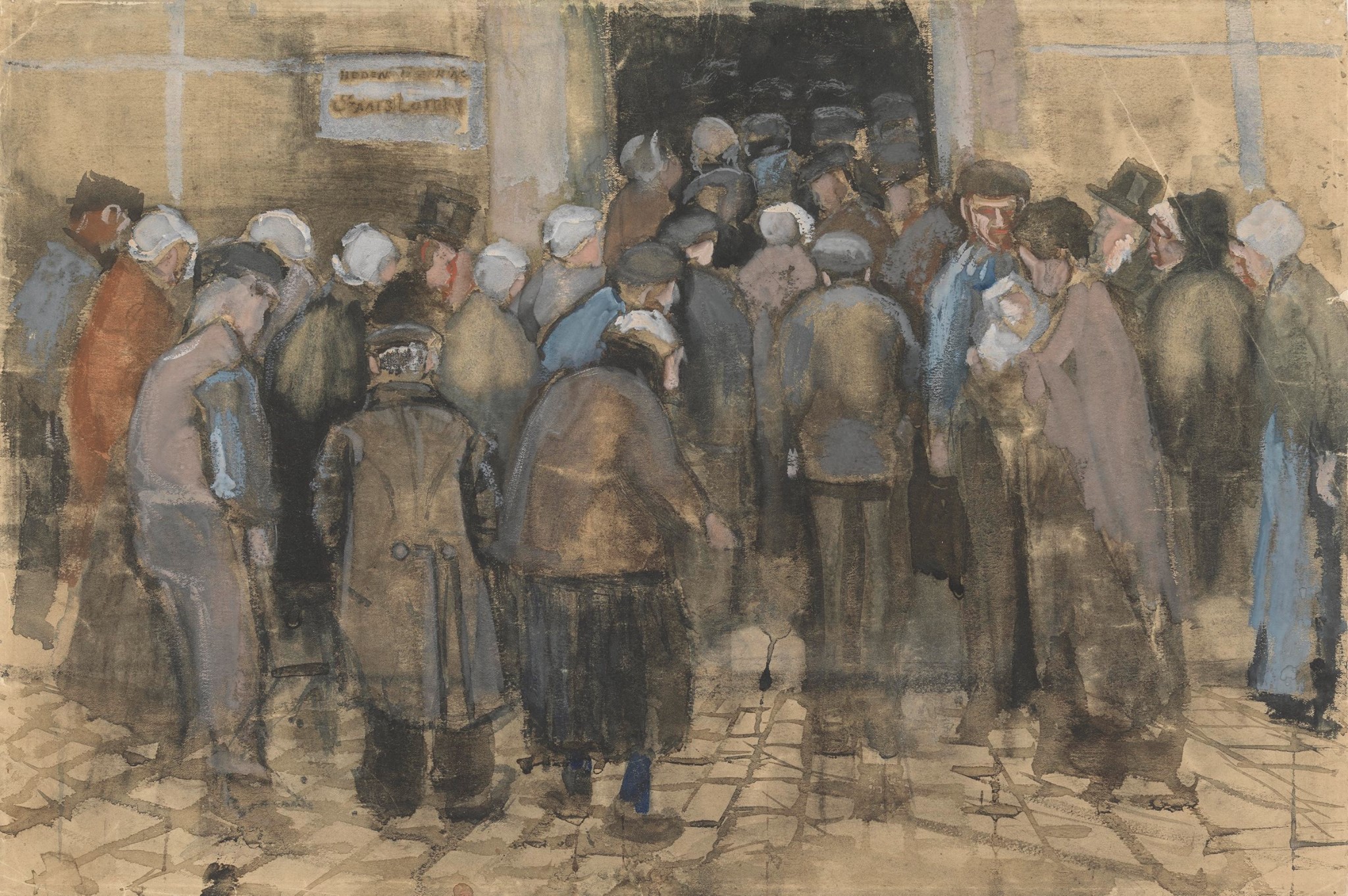
Vincent van Gogh | The Poor and Money, 1882

Vincent van Gogh | The Poor and Money, 1882

'Drawing For National Lottery Today' - says the sign on the wall.
Many people have showed up for the event. Vincent wrote to his brother Theo that he saw this scene on a rainy day in The Hague.
He was moved by the vain hope of these shabbily dressed 'poor souls'.
Would the hard-earned money they spent on lottery tickets gain them anything at all?

Vincent van Gogh | The Poor and Money, 1882 (chalk, watercolour, pen and ink, on paper) | Van Gogh Museum, Amsterdam

Read More

Vincent van Gogh | The Poor and Money, 1882

'Drawing For National Lottery Today' - says the sign on the wall.
Many people have showed up for the event. Vincent wrote to his brother Theo that he saw this scene on a rainy day in The Hague.
He was moved by the vain hope of these shabbily dressed 'poor souls'.
Would the hard-earned money they spent on lottery tickets gain them anything at all?

Vincent van Gogh | The Poor and Money, 1882 (chalk, watercolour, pen and ink, on paper) | Van Gogh Museum, Amsterdam

Vincent van Gogh | Pietà (after Delacroix), 1889

Vincent van Gogh | Pietà (after Delacroix), 1889

Van Gogh based his Pietà on a lithograph of a painting by Eugène Delacroix.
This image of the Virgin Mary mourning the dead Christ is, however, more a variation on the original work than a copy.
Van Gogh has taken Delacroix’s theme and composition and added his own colour and personal signature.


Read More

Vincent van Gogh | Pietà (after Delacroix), 1889

Van Gogh based his Pietà on a lithograph of a painting by Eugène Delacroix.
This image of the Virgin Mary mourning the dead Christ is, however, more a variation on the original work than a copy.
Van Gogh has taken Delacroix’s theme and composition and added his own colour and personal signature.


Vincent Van Gogh | The sowers series

Vincent Van Gogh | The sowers series


Peasant imagery and especially that of the 'Sower' was something that Van Gogh turned to numerous times throughout his career.
His affiliation with this subject was partly as a response to the work of the romantic Realists such as Millet, and a reflection of his own socialist ideals.
The sower in particular was a figure that Van Gogh saw in terms of representing the eternal cycle of agricultural life, of honorable endeavor and tradition, and symbolized these qualities to the artist.

Read More

Vincent Van Gogh | The sowers series


Peasant imagery and especially that of the 'Sower' was something that Van Gogh turned to numerous times throughout his career.
His affiliation with this subject was partly as a response to the work of the romantic Realists such as Millet, and a reflection of his own socialist ideals.
The sower in particular was a figure that Van Gogh saw in terms of representing the eternal cycle of agricultural life, of honorable endeavor and tradition, and symbolized these qualities to the artist.

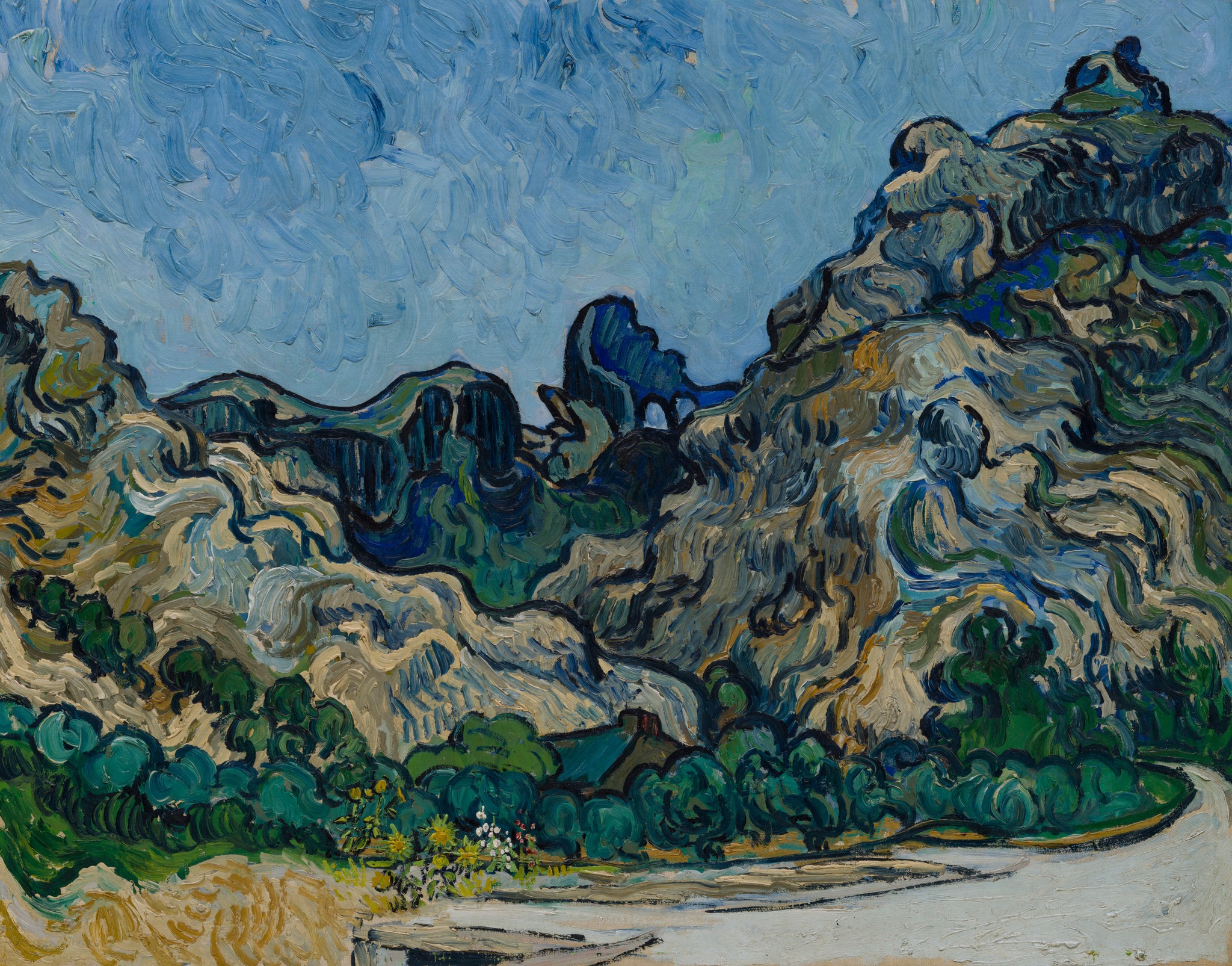
Vincent van Gogh | Mountains at Saint-Rémy, 1889

Vincent van Gogh | Mountains at Saint-Rémy, 1889

"Always continue walking a lot and loving nature, for that's the real way to learn to understand art better and better.
Painters understand nature and love it, and teach us to see" 
- Vincent van Gogh's letter to his brother Theo, 1874.

Vincent van Gogh | Mountains at Saint-Rémy, 1889 | Solomon R. Guggenheim Museum, New York

During the years preceding his suicide in 1890, Vincent van Gogh suffered increasingly frequent attacks of mental distress, the cause of which remains unclear.
"Mountains at Saint-Rémy" was painted in July 1889, when Van Gogh was recovering from just such an episode at the hospital of Saint-Paul-de-Mausole in the southern French town of Saint-Rémy.

Read More

Vincent van Gogh | Mountains at Saint-Rémy, 1889

"Always continue walking a lot and loving nature, for that's the real way to learn to understand art better and better.
Painters understand nature and love it, and teach us to see" 
- Vincent van Gogh's letter to his brother Theo, 1874.

Vincent van Gogh | Mountains at Saint-Rémy, 1889 | Solomon R. Guggenheim Museum, New York

During the years preceding his suicide in 1890, Vincent van Gogh suffered increasingly frequent attacks of mental distress, the cause of which remains unclear.
"Mountains at Saint-Rémy" was painted in July 1889, when Van Gogh was recovering from just such an episode at the hospital of Saint-Paul-de-Mausole in the southern French town of Saint-Rémy.

Van Gogh, Rembrandt and the Rijksmuseum

Van Gogh, Rembrandt and the Rijksmuseum

Vincent van Gogh travelled to Amsterdam in 1885 to visit the Rijksmuseum, which had recently opened.
On the day of his visit he painted his "View of Amsterdam from Central Station".
The paint still wet, he took the new work with him to the Rijksmuseum.

Vincent van Gogh | Wheat field, 1888 | Rijksmuseum

Read More

Van Gogh, Rembrandt and the Rijksmuseum

Vincent van Gogh travelled to Amsterdam in 1885 to visit the Rijksmuseum, which had recently opened.
On the day of his visit he painted his "View of Amsterdam from Central Station".
The paint still wet, he took the new work with him to the Rijksmuseum.

Vincent van Gogh | Wheat field, 1888 | Rijksmuseum

Vincent van Gogh | Irises, 1890

Vincent van Gogh | Irises, 1890

In May 1890, just before he checked himself out of the asylum at Saint-Rémy, Van Gogh painted four exuberant bouquets of spring flowers, the only still lifes of any ambition he had undertaken during his yearlong stay: two of irises, two of roses, in contrasting color schemes and formats.
In the Museum’s Irises he sought a “harmonious and soft” effect by placing the “violet” flowers against a “pink background”, which have since faded owing to his use of fugitive red pigments.

Vincent van Gogh | Irises, 1890 | Metropolitan Museum of Art

Read More

Vincent van Gogh | Irises, 1890

In May 1890, just before he checked himself out of the asylum at Saint-Rémy, Van Gogh painted four exuberant bouquets of spring flowers, the only still lifes of any ambition he had undertaken during his yearlong stay: two of irises, two of roses, in contrasting color schemes and formats.
In the Museum’s Irises he sought a “harmonious and soft” effect by placing the “violet” flowers against a “pink background”, which have since faded owing to his use of fugitive red pigments.

Vincent van Gogh | Irises, 1890 | Metropolitan Museum of Art

Vincent van Gogh's suicide letter

Vincent van Gogh's suicide letter

Vincent van Gogh was an influential artist during the nineteenth century.
Widely believed to have been struggling with depression and insanity, he went out to a nearby field and shot himself in the chest, before stumbling back to his house where his brother Theo cared for him for two days, before he finally died.
Although he had sent a letter to Theo only three days earlier, he was carrying another letter to his brother on his person at the time of his suicide, largely seen as a suicide note.

Van Gogh severed his own ear with a razor in 1888 | The Courtauld Gallery London

Read More

Vincent van Gogh's suicide letter

Vincent van Gogh was an influential artist during the nineteenth century.
Widely believed to have been struggling with depression and insanity, he went out to a nearby field and shot himself in the chest, before stumbling back to his house where his brother Theo cared for him for two days, before he finally died.
Although he had sent a letter to Theo only three days earlier, he was carrying another letter to his brother on his person at the time of his suicide, largely seen as a suicide note.

Van Gogh severed his own ear with a razor in 1888 | The Courtauld Gallery London

Vincent van Gogh | Studies of heads

Vincent van Gogh | Studies of heads

Van Gogh considered the modern portrait to be the most important genre for painters.
"What I’m most passionate about, much more than all the rest in my profession - is the portrait, the modern portrait.
I seek it by way of colour, and am certainly not alone in seeking it in this way’, wrote Vincent to this sister Willemien in 1890.

Vincent van Gogh | Head of a woman | Van Gogh Museum

Read More

Vincent van Gogh | Studies of heads

Van Gogh considered the modern portrait to be the most important genre for painters.
"What I’m most passionate about, much more than all the rest in my profession - is the portrait, the modern portrait.
I seek it by way of colour, and am certainly not alone in seeking it in this way’, wrote Vincent to this sister Willemien in 1890.

Vincent van Gogh | Head of a woman | Van Gogh Museum